
I was sitting on a *panel recently, and the question posed was: From the perspective of local distributors, where does Nigeria’s gas value chain still break down most frequently?

It was a refreshingly different and necessary question given the context of Nigeria’s gas sector.
The overriding narrative around Nigeria’s gas sector remains one of abundance, and the numbers support it. The latest figures from the Nigerian Upstream Petroleum Regulatory Commission (NUPRC) put Nigeria’s gas reserves at 215.19 trillion cubic feet as of January 1, 2026.
These figures are constantly communicated as proof of the scale of the opportunity for gas utilisation. But actual in-country utilisation remains well below the potential represented by those massive reserves.
Against this background, the question offered an opportunity to examine the blockers to utilisation from the perspective of local gas distributors; the players who sit between gas supply and the end user, moving gas through physical and/or virtual pipeline networks, trading gas, and providing the supporting secondary infrastructure needed to get gas to where it will ultimately be utilised.
In executing this role, this important segment of the value chain faces several bottlenecks that prevent natural gas from reaching end users efficiently.
These difficulties start with supply, where gas availability does not automatically mean that a distributor can access it.
If, for instance, a gas distributor, Company A, wants to build a business supplying gas to industrial customers, it may have identified two potential customers, Companies B and C, and have a clear view of the infrastructure required to serve them.
But before Company A can make those investments with confidence, it needs to know where its gas will come from, how much it can secure, at what price and for how long.
That is where a Gas Sale and Purchase Agreement (GSPA) becomes important.
A GSPA is essentially the contract that sets out the commercial terms under which gas will be supplied and purchased, including agreed volumes, pricing, delivery arrangements and other obligations.
For a distributor, having a bankable long-term supply agreement provides the certainty needed to invest in infrastructure and make credible commitments to its own customers.
Without sufficient certainty of supply, it becomes difficult to finance infrastructure, build distribution networks or enter into long-term contracts with customers.
Domestic distributors also compete for supply alongside export markets, power generation, and gas-based industries. So, the question is not simply whether Nigeria has gas. It is whether distributors can secure bankable supply at a price and on terms that allow the entire distribution chain to work.
Then there is the midstream. Once gas has been secured, getting it to the customer efficiently is another challenge.
For distributors using existing pipeline networks, gas accounting and shrinkage can have a direct impact on the economics of the business.
Take Company A again. Suppose it contracts and pays for a particular volume of gas at the source. By the time that gas reaches the point where Company A takes delivery, the measured volume may be lower because of losses or discrepancies within the transportation system. Current industry reports place these losses at 3–6%, which can have a significant cumulative impact over time.
When the distributor bears that cost, its margins are reduced. When it is passed through the value chain, the delivered cost of gas increases. The economics become less attractive, and affordability is impaired.
Consequently, businesses are disincentivised from investing in gas distribution infrastructure and therefore access and utilisation are threatened despite the abundance and availability based on the reserves numbers and improved development of primary infrastructure.
This friction also continues downstream, where getting gas to the end customer requires infrastructure, logistics and approvals. Companies investing in distribution infrastructure have to navigate permits and approvals across different government agencies and levels. A one-stop-shop approach that can make the process coordinated and predictable remains absent.
For companies using trucks to move CNG or LNG to customers outside the reach of existing pipeline infrastructure, the condition and availability of road networks also affect the final cost and reliability of supply.
Another bottleneck is access to existing infrastructure. A company looking to enter the market without building an entirely new pipeline network may seek access to existing infrastructure through third-party arrangements. Nigeria’s Gas Transportation Network Code provides a framework for open and competitive access to gas transportation infrastructure, supported by NMDPRA’s Network Code Electronic Licensing and Administrative System.
But this access to infrastructure does not necessarily mean that it is commercially and timeously accessible. For new companies, the cost of using existing infrastructure can make the business case unworkable, effectively creating another barrier to entry and scale.
Despite these challenges, it is important to acknowledge that progress is being made by local distributors.
At the same event, the Executive Director for Distribution Systems, Storage and Retailing Infrastructure (DSSRI) at the NMDPRA announced collective milestones for the gas distribution subsector as about: 400 customers, 10 gas distribution licences issued, 200 MMscf/d distribution, and 700 km of pipeline network in operation.
However, for sustained growth, the conversation must shift from abundance to accelerating access and affordability by removing the bottlenecks that prevent distributors from securing reliable gas supply, accessing infrastructure, navigating approvals and ultimately delivering gas to customers at commercially viable prices within the shortest possible time that makes cash flow and economics meaningful.
That is the shift required to turn Nigeria’s gas potential into sustained utilisation and growth.
John Kadiri is the MD/CEO at Alpha Maxvalue Energy & Renewables Ltd and the Executive Secretary of the Association of Local Distributors of Gas
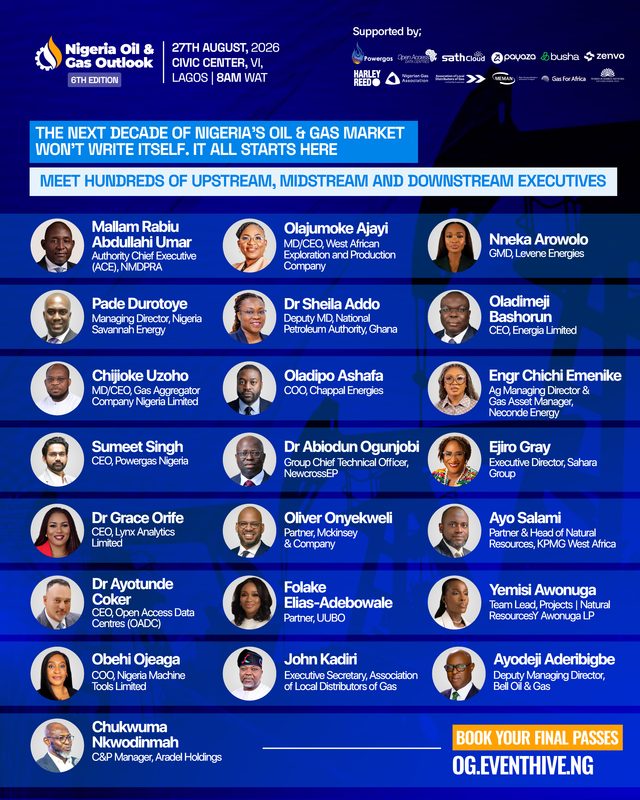
*This is Note 1 from my participation in the Nigeria Oil and Gas Outlook 2026 organised by Africa Energy Series, where I contributed to a panel alongside Chijioke Uzoho, MD/CEO, Gas Aggregation Company Nigeria Limited; Engr. Chichi Emenike FNSE, MCIoD, Ag. Managing Director & Gas Asset Manager, Neconde Energy; Pade Durotoye, Managing Director, Savannah Energy; Sumeet Singh, CEO, Powergas Nigeria; Ayo Salami, Partner & Head of Natural Resources, KPMG West Africa and moderated by Amel Grabsi, Regional Director, Gas for Africa.
Please look out for Note 2.